
The Best Climbing Toys for Toddlers
Toddlers love to move: pulling themselves up, climbing, sliding, balancing, hanging, and trying the same route again and again. The right climbing toy creates a dedicated space for active play at home without constantly needing new play ideas. In this guide, you’ll learn which types of climbing toys are suitable for toddlers and which solution best fits your child and your everyday family life.

Key Points at a Glance
You can narrow down your choice significantly with five simple questions:

For first climbing attempts. Manageable, easy-to-reach climbing routes help your child explore and repeat movements independently.
For highly active children. Versatile systems that combine climbing, sliding, hanging, or different setup options offer more variety than toys with only one function.
For smaller spaces. Compact or foldable solutions bring active play indoors without permanently taking over the entire room.
For long-term use. Durable base systems with accessories and different play options can grow with your child’s changing interests.
For open-ended play. Good climbing toys don’t dictate every step of play. Your child decides how to climb, combine elements, repeat movements, and explore new routes.

What to Look for When Buying
1. Age and Developmental Stage
Toddlers develop their movement skills quickly. Between taking their first confident steps and climbing independently, major developmental changes can happen within a short period of time. That’s why you should consider not only your child’s age, but also what they can already do independently and which types of movement they naturally seek out.
A good climbing toy offers an achievable challenge: exciting enough to encourage your child to try something new, but not so complex that they need help with every movement. Always follow the age recommendations for the specific product.
2. Variety of Movement
Climbing is just one possibility. For toddlers, an active-play product becomes especially engaging when it supports different types of movement: climbing up, climbing down, sliding, crawling through, hanging, or balancing.
More functions do not automatically mean more electronics or complicated mechanisms. Often, just a few well-designed wooden elements that can be combined in different ways are enough for your child to keep discovering new routes. This openness is exactly what makes an active-play product so versatile in everyday life.
3. Size and Space at Home
Measure the intended play area before purchasing. Consider not only the dimensions of the product itself, but also enough free space around it for movement, as well as additional room for ramps, slides, or accessories.
If space is limited, a compact or foldable model may be the better choice. In a larger children’s room or playroom, a permanently assembled system that combines several types of movement can be a practical option.
4. Safety and Manageable Challenges
Climbing toys should encourage your child to explore while still matching their current abilities. Look for a stable construction, carefully finished surfaces, appropriate age recommendations and weight limits, as well as a suitable location.
The area around the climbing toy should be kept clear of hard furniture edges, radiators, and frequently used walkways. Depending on the product, a suitable safety mat or appropriate flooring should also be part of the setup.
5. Open-Ended Play Instead of Short-Term Entertainment
Toddlers often repeat the same movements many times. That is exactly where the value of open-ended active play lies: the product does not dictate what should happen next. Your child can use the same setup as a climbing route today and as part of a self-created obstacle course tomorrow.
Look for toys that leave room for your child’s own ideas. A good climbing toy does not rely on effects to keep your child engaged, but instead encourages real movement and independent exploration.
6. Materials and Craftsmanship
Climbing toys are used intensively, handled frequently, and often remain visible in the living space. Durable wood, carefully finished edges, and a stable construction are therefore important factors when choosing a product.
CLIFF focuses on a natural wood look, EU production, and a calm, home-friendly design. This allows the active-play product to blend naturally into children’s rooms and living spaces instead of feeling like a bright, intrusive object.
7. Longevity and Expandability
A climbing toy should stay interesting for more than just a few weeks. Consider whether the way it is used can evolve over time: Are there different setup options? Can accessories be added? Do new movement challenges emerge as your child becomes more confident?
Especially with a larger purchase, it is worth choosing a system that can adapt to new interests. This allows a familiar base product to keep offering new challenges again and again.
Which Solution Is Right for You?

For First Independent Climbers
As your child becomes more confident on their feet and starts exploring their first climbing routes, a manageable setup with clear handholds and footholds can be a good choice. Pikler-inspired and versatile systems give your child space to explore independently without unnecessarily overcrowding the play area.

For Small Children’s Rooms and Apartments
When active-play space and living space are shared, a climbing toy should offer as much play value as possible within a practical footprint. Compact models or foldable designs make it easier to integrate active movement into everyday life without taking away from the room’s other functions.
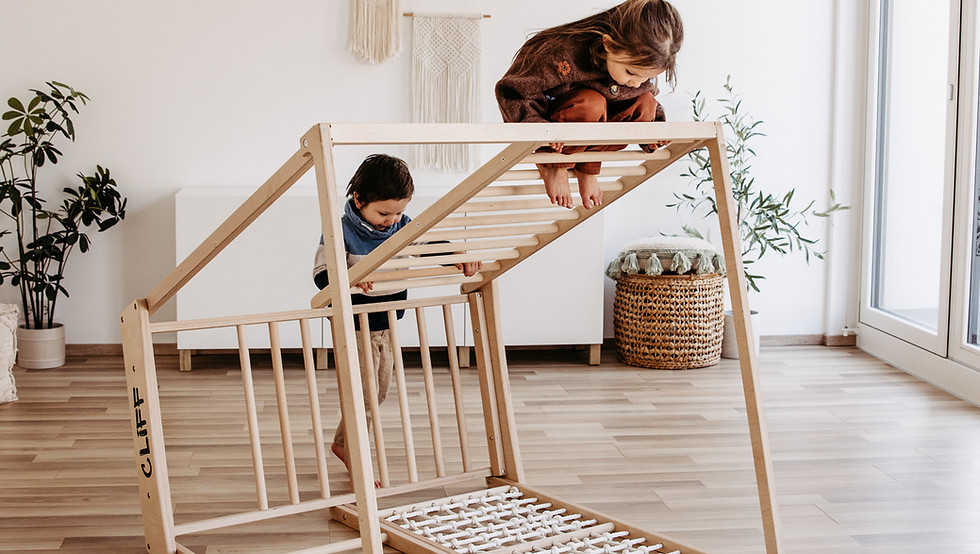
For Highly Active Children
If your child is constantly looking for new climbing routes, enjoys hanging, sliding, and combining different movements, a more versatile system can be a better fit. Multiple play positions and expandable accessories create new challenges without the need for another large play structure.

Which CLIFF Solution Is Right for You?
Here are our top furniture picks for you.
CLIFF Pro – For Versatile Active Play Over Several Years
CLIFF Pro is designed for families who want to create a dedicated and versatile active-play area at home. Five play positions and numerous expansion options offer new ways to climb, hang, and play again and again.
-
5 play positions
-
Safety mat included
-
Expandable with a wide range of accessories

CLIFF Flex – When Foldability Matters in Everyday Life
CLIFF Flex is a foldable climbing solution for families who want to use their space flexibly. Three play positions provide variety, while the frame can be folded away to save space when needed. A safety mat is already included.
-
Foldable and space-saving
-
3 play positions
-
Safety mat included

CLIFF Compact – More Active Play in Less Space
CLIFF Compact combines multiple types of movement in a compact design. The slide ramp and trapeze are already included, making it ideal for families who want to combine climbing, sliding, and hanging in a child’s room.
-
Compact design
-
Slide ramp and trapeze included
-
Suitable for children from 18 months

CLIFF Combo – Pikler-Inspired and Versatile
CLIFF Combo is ideal for families looking for a versatile climbing solution for children who are already walking. Multiple setup options create different climbing routes, and the system can be integrated into active-play setups in new ways again and again.
-
Pikler- and Montessori-inspired
-
Multiple setup options
-
Versatile and expandable

Quick Check Before Buying
If these points fit your child and your everyday life, choosing the right product becomes much easier.
-
Is the climbing toy suitable for my child’s age and current stage of development?
-
Is the play area safely prepared and is the intended surface suitable?
-
Which types of movement does my child seek out most often – climbing, sliding, hanging, or balancing?
-
Would we like to expand the system later with accessories or additional active-play modules?
-
Do we have enough space for the product and a clear area for movement?
-
Do the materials, craftsmanship, and design match our needs and our home?
-
Should the climbing toy remain set up permanently, or should it be easy to store away when needed?

Safety, Materials & Quality
With an indoor climbing frame, active play and safety go hand in hand. That’s why the setup, age recommendations, weight limits, materials, and safe use of each model should be easy to understand before purchasing.
Safety
Pay attention to the age recommendations and weight limits, ensure stable assembly, and prepare a suitable play area.
Materials
Durable wood, carefully finished surfaces, and a pleasant feel are especially important for climbing toys designed for intensive use.
Crafted in the EU
CLIFF products are made in the EU using EU-sourced materials and durable, repairable product designs.
Shipping & Returns
Before purchasing, check the included items, assembly requirements, shipping terms, and return options for your chosen product.

Frequently Asked Questions Before Buying
Still unsure which CLIFF is right for you?
The best climbing toy isn’t the one with the most features, but the one your child enjoys using independently and that fits your home. Consider your child’s stage of development, preferred types of movement, available space, and how long you want to use it – then choose the solution that truly fits your everyday life.
Less Screen Time. More Real Play.
