
The best active play toys for active children
Some children are almost constantly on the move: They climb onto the sofa, build obstacle courses, jump, balance, or repeatedly seek new physical challenges. A good active play toy supports this natural desire to move and creates opportunities for active, independent play at home. This guide helps You choose a solution that suits Your child, Your available space, and Your everyday life.

The Essentials at a Glance
You can significantly narrow down the selection with five simple questions:
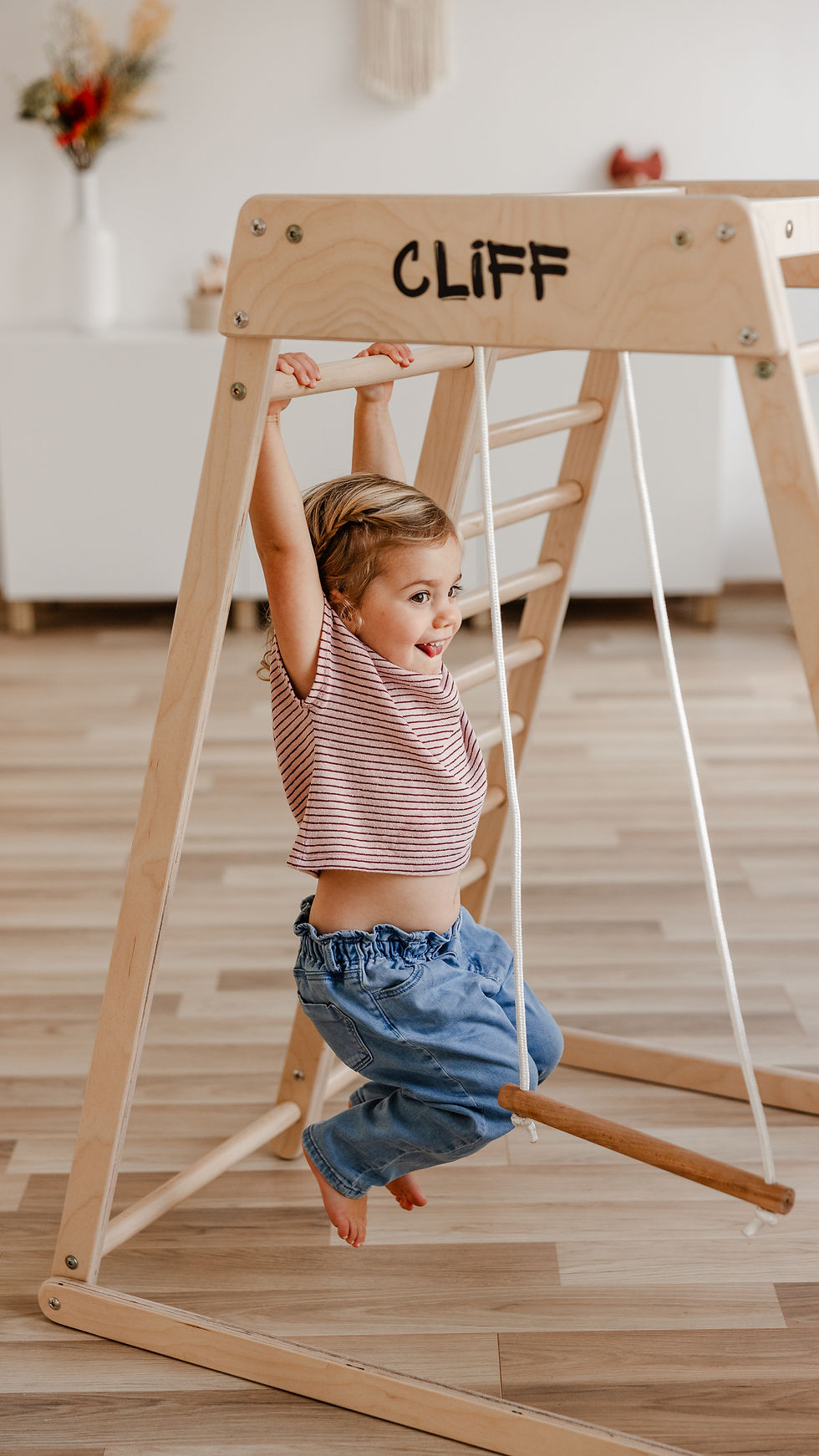
A strong desire to move? Look for multiple types of movement rather than just one function. Climbing, hanging, sliding, and balancing provide different challenges.
Gets bored quickly? Versatile and expandable products can be reconfigured in different ways, creating variety without constantly buying new toys.
Want active play to fit into everyday life? Choose the size and setup to suit your home. Even in a limited space, a well-planned active play area can work effectively.
Is long-term use important? Robust core systems and accessories can grow with Your child’s abilities and interests.
Less Screen Time, More Real Play? Open-ended active play toys do not provide ready-made entertainment. Your child decides what to explore and repeat.

What to Look for When Buying
1. Interest in active play and developmental stage
Not all active children are the same. One child primarily wants to climb, another balances on every edge, while a third loves swinging or constantly builds new obstacle courses. Therefore, observe which movements Your child seeks out voluntarily and can already perform safely.
The right toy should reflect these interests while also offering new, achievable challenges. Always follow the age and usage instructions for the respective product and choose within this framework according to Your child’s current abilities.
2. Variety of active play
For active children, versatility is often more important than size alone. Different forms of movement, such as climbing, sliding, hanging, swinging, balancing, or crawling through, provide more variety than additional height alone.
The more meaningful variations a core system offers, the easier it is for Your child to develop new play ideas independently. This keeps the active play experience open-ended and allows it to evolve with their play.
3. Open-ended and independent play
A good active play toy does not need to entertain Your child with lights, sounds, or predefined tasks. It provides an environment in which movement can develop. Your child decides which route to take and which movement to repeat.
This open-ended approach is particularly suitable for families who do not want to simply replace screen time with another form of passive entertainment. The goal is real play: active, physical, and self-initiated.
4. Space and everyday practicality
Even an active child does not automatically need a huge playroom. What matters is how effectively the available space is used. Measure the area and allow not only for the product itself, but also for free movement space and room for extensions.
Also consider whether the active play structure can remain permanently set up or needs to be moved out of the way regularly. Compact and foldable solutions can help make active play a natural part of everyday life.
5. Adaptability and new challenges
At some point, children master movements so confidently that a familiar task loses its appeal. That does not mean an entirely new large toy is needed straight away. A different configuration or a new accessory can turn a familiar base into a new challenge.
If Your child quickly seeks new movement challenges, adaptable or expandable systems are particularly appealing. Check which play positions are possible and which accessories can be added later.
6. Safety, materials and craftsmanship
Active play toys are used intensively. Stable construction, carefully finished surfaces, appropriate age and load-capacity specifications, and a safely prepared location are therefore among the most important selection criteria.
CLIFF focuses on a natural wood aesthetic, high-quality workmanship, and EU production. The calm design blends into modern living rooms and children’s rooms.
7. Long-term use instead of short-term entertainment
When making a larger purchase, it is worth considering how long the product can remain engaging. Can Your child use it in different ways? Are extensions available? Can a climbing challenge later become an obstacle course or a new active play landscape?
A durable active play toy does not need to constantly do something new. It should allow Your child to keep discovering new ways to use it.
Which solution is right for you?


Which CLIFF Solution Is Right for You?
Here are our top furniture picks for you.
CLIFF Pro – for versatile active play and long-term use
CLIFF Pro creates a dedicated active play area for children who love climbing, hanging and discovering new ways to move. Five play positions and a wide range of expansion options allow the level of challenge to change over time.
-
5 play positions
-
Safety Mat included
-
expandable with a wide range of accessories

CLIFF Balance – for balance and creating your own obstacle courses
CLIFF Balance adds a different form of active play to climbing. Five double-sided balance boards and six connectors can be combined to create different paths and obstacle courses.
-
5 double-sided balance boards
-
6 connectors
-
different obstacle courses possible

CLIFF Compact – multiple ways to move in a compact space
CLIFF Compact combines climbing, sliding and hanging in one compact design. The slide ramp and trapeze are already included.
-
compact design
-
slide ramp and trapeze included
-
multiple forms of active play in one system

CLIFF Combo – for versatile climbing and open-ended play
CLIFF Combo is a Pikler- and Montessori-inspired solution that can be set up in multiple configurations. Its adaptable design is ideal for children who enjoy discovering new ways to play.
-
multiple setup options
-
Pikler- and Montessori-inspired
-
adaptable and expandable

Quick check before buying
If these points fit your child and your everyday routine, choosing the right product becomes much easier.
-
Which types of movement does my child seek out most often in everyday life?
-
Should the active play equipment stay set up permanently or be easy to store away when needed?
-
Does the product suit my child’s age and developmental stage?
-
Can the level of challenge be adjusted later with new setups or accessories?
-
Does the product offer more than one way to move or play?
-
Are the materials, craftsmanship, safety and design suitable for long-term use in our home?
-
Do We Have Enough Space for the Product and a Clear Active Play Area?

Safety, Materials & Quality
With an indoor climbing frame, active play and safety go hand in hand. That is why the assembly, age recommendations, load capacity, materials, and safe use of each model should be easy to understand before purchasing.
Safety
Pay attention to the age and load-capacity specifications, stable assembly, and sufficient free space for movement around the product.
Materials
Durable wood and carefully finished surfaces are particularly important when an active play product is used intensively every day.
European manufacturing
CLIFF manufactures in the EU and focuses on EU-sourced materials, durable construction and repairable product designs.
Shipping & Returns
Before purchasing, check the included components, assembly requirements, shipping conditions and return options for your chosen model.

Frequently Asked Questions Before Buying
Still unsure which CLIFF is right for you?
The best solution for an active child is not automatically the largest product. What matters is the kind of movement your child enjoys, how much space you have, and how versatile the product can be in everyday life. Choose a solution that feels accessible today and still allows for new ideas tomorrow.
Less Screen Time. More Real Play.
